
Managing Bookings, Digital Marketing, Reputation, and Data Analytics
Abstract
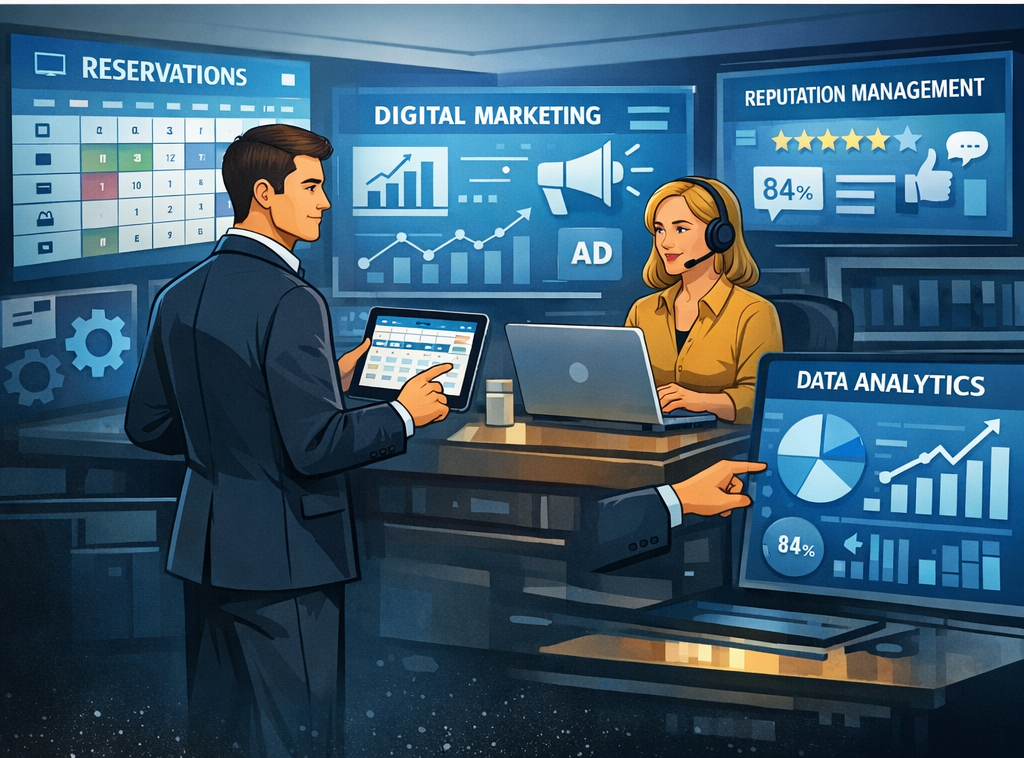
The hospitality industry has evolved into a highly digitized ecosystem where operational complexity is driven by interconnected systems and real-time decision-making. This article explores four critical pillars – reservation management, digital marketing, reputation management, and data analytics – and how they collectively shape the daily operations of hotels and resorts.
1. Reservation Management: From Manual Logs to Smart Systems
Modern reservation systems are no longer isolated tools. They are part of a larger ecosystem that includes:
- Property Management Systems (PMS): Centralized platforms like Opera, Mews, Picasso Digital or Cloudbeds that manage room inventory, guest profiles, and billing.
- Channel Managers: Tools that sync availability across OTAs (Booking.com, Expedia) and direct booking engines.
- Dynamic Pricing Engines: Algorithms that adjust room rates based on demand, seasonality, and competitor pricing.
Challenges:
- Avoiding overbookings and ghost reservations.
- Integrating real-time updates across platforms.
- Managing group bookings and corporate contracts.
Reference:
- Ivanov, S. (2023). Hotel Revenue Management and Distribution. Journal of Hospitality Technology.
2. Digital Marketing: Precision Targeting in a Crowded Market
Marketing in hospitality is no longer about brochures and billboards. It’s about:
- SEO and SEM: Ensuring visibility on Google and Bing.
- Social Media Campaigns: Targeted ads on Instagram, Facebook, and TikTok.
- Email Automation: Personalized offers based on guest behavior.
- Influencer Collaborations: Leveraging travel bloggers and content creators.
Key Metrics:
- Conversion rate, ROAS (Return on Ad Spend), CPA (Cost per Acquisition).
Reference:
- Buhalis, D. & Leung, R. (2024). Smart Tourism and Digital Marketing. Tourism Management Perspectives.
3. Reputation Management: The Digital Word-of-Mouth
Online reviews can make or break a hotel’s brand. Reputation management involves:
- Monitoring Platforms: Google Reviews, TripAdvisor, Trustpilot.
- Sentiment Analysis: Using AI to detect patterns in guest feedback.
- Automated Responses: Tools that reply to reviews professionally and promptly.
Impact: A Harvard Business Review study (2025) found that a 1-star increase on review platforms can boost revenue by up to 9%.
Reference:
- Sparks, B. & Browning, V. (2025). Online Reviews and Hotel Performance. Cornell Hospitality Quarterly.
4. Data Analytics: The Brain Behind the Operation
Data is the new currency in hospitality. Analytics tools help:
- Forecast demand and optimize staffing.
- Personalize guest experiences.
- Identify operational bottlenecks.
Tools Used:
- Power BI, Tableau, Revinate, Duetto.
Reference:
- Guttentag, D. (2025). Big Data in Hospitality Operations. International Journal of Hospitality Management.
Conclusion
The integration of digital tools across booking, marketing, reputation, and analytics has transformed hospitality into a data-driven, guest-centric industry. Professionals must now master both service excellence and technological fluency to thrive.
Abdallah Salah Senousy Ahmed, Lycksele